Stablecoins for Cross-Border Payments: A Practical Business Guide
How stablecoin payments work for businesses: on- and off-ramp costs, risks, a comparison with bank transfers, and how to choose a regulated provider.


Contents
Stablecoins are digital tokens designed to track the value of a reference asset, most commonly the US dollar. They can be transferred between wallets around the clock, including outside banking hours.
The blockchain transfer is one stage of a cross-border payment. A company may also need to convert fiat currency into stablecoins through a licensed provider, arrange a local-currency payout for the beneficiary and confirm that the route complies with the rules in each jurisdiction involved.
For treasury teams, the first question is whether a stablecoin route is permitted for their activity and counterparties. Only then does it make sense to ask whether it can deliver usable funds faster, at a lower all-in cost or with fewer operational constraints. This guide explains how the process works and what businesses should assess. It is educational and does not recommend any stablecoin or route.
Key points
- Stablecoins can move between wallets in minutes. End-to-end settlement can take longer when the beneficiary needs local currency.
- Stablecoin transactions through regulated providers are subject to the same kind of controls as bank transfers, including KYC, anti-money-laundering checks and sanctions screening.
- Regulatory permissions, conversion costs, local payout access and provider controls determine whether a route is viable.
- Stablecoins may be an option in some slow or expensive corridors, where their use is permitted. A competitively priced bank transfer may still cost less.
- Key risks include reserve quality, issuer exposure, address freezes, irreversible transfers and dependence on a reliable off-ramp.
- Verify the provider’s licence and confirm that its permissions cover the specific services your business needs. Businesses in the UAE should check the limitations and requirements imposed by the Central Bank of the UAE (CBUAE), VARA and other relevant authorities on the use of virtual assets.
What are stablecoins?
A stablecoin is a digital token designed to maintain a stable value relative to a reference asset. A US dollar stablecoin, for example, aims to trade close to one dollar and can be sent between digital wallets over a blockchain.
Most stablecoins reference fiat currencies, particularly the US dollar. Because they aim to limit exposure to the price swings associated with assets such as Bitcoin, fiat-referenced stablecoins are used as a medium for transfers and settlement.
Two of the largest examples are USDT, issued by Tether, and USDC, issued by Circle. Both target a one-to-one exchange rate with the US dollar. Circle also issues EURC, which tracks the euro. MidChains publishes its current list of supported assets; inclusion on that list is not a recommendation.
Holding a fiat-backed stablecoin gives a business exposure to a private issuer and its reserve and redemption arrangements. The token itself carries no bank deposit protection. Direct redemption rights depend on the issuer’s terms, the holder’s eligibility and applicable law.
Fiat-referenced stablecoins and reserves
A typical fiat-backed issuer accepts currency, issues tokens and holds reserve assets to support redemption at face value. Treasury teams should examine what those reserves contain, how readily they can be converted to cash under stress and who verifies the issuer’s disclosures.
Short-dated government bills, repurchase agreements backed by those bills and bank deposits have different risk and liquidity profiles from commercial paper, secured loans, precious metals or digital assets. Issuers also differ in how they disclose their reserves and manage redemptions.
Major issuers publish periodic reserve attestations. These provide assurance on specified reserve information as of particular reporting dates. A full financial statement audit has a broader scope. Before holding or accepting a stablecoin, review the issuer, reserve composition, reporting frequency, redemption eligibility, minimum amounts and expected timelines.
The issuer information below is drawn from the issuers’ own public disclosures. MidChains has not independently audited or verified those disclosures, and the risk of relying on them remains with the client.
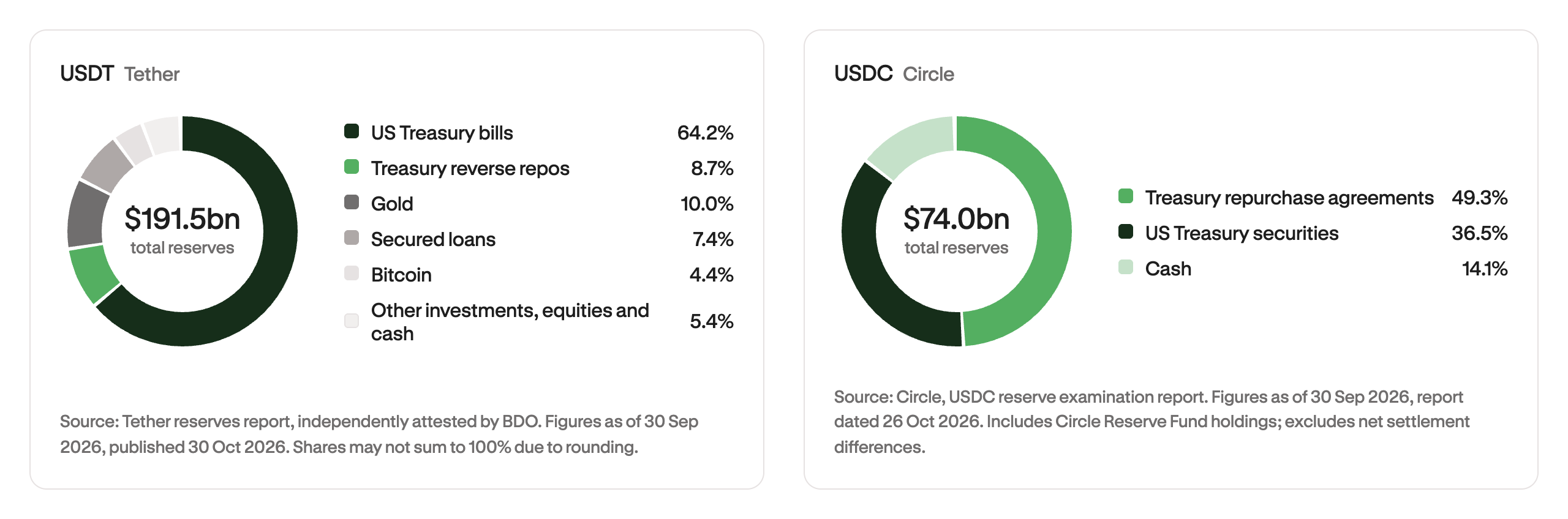
How USDT is backed
According to Tether’s disclosures, the majority of USDT reserves are held in liquid, short-duration instruments, including US Treasury bills and reverse repurchase agreements. Reserves also include assets such as secured loans, gold and Bitcoin. Declines in gold or Bitcoin prices can reduce the value of the reserve buffer, all else being equal. Tether publishes quarterly reserve reports with an independent attestation from BDO.
How USDC is backed
According to Circle’s disclosures, USDC reserves are held in bank deposits, short-dated US Treasuries and overnight reverse repurchase agreements backed by Treasuries. Most of the reserves are held in the Circle Reserve Fund, a government money market fund managed by BlackRock. Circle publishes monthly Deloitte attestations comparing reserve value with USDC in circulation on the reporting dates.
Stablecoins versus other digital assets
When a business receives Bitcoin, the value of the payment can change materially before it converts the proceeds. A fiat-backed stablecoin reduces that price exposure while it maintains its peg. The business still faces issuer, redemption and settlement risks, and stablecoins can still lose value.
For a treasury team, the focus shifts to who issued the token, whether it can be converted into the currency the business needs and whether each jurisdiction permits the proposed transaction.
Algorithmic stablecoins use mechanisms such as supply adjustments and market incentives to maintain their peg. Their design can introduce additional risks, and some jurisdictions, including the UAE, restrict services relating to them.
How stablecoin payments work
A cross-border payment that starts and ends in fiat typically has three stages. The wallet-to-wallet transfer is often the fastest. The two conversion stages usually determine the cost, timing, compliance requirements and practicality of the full route.
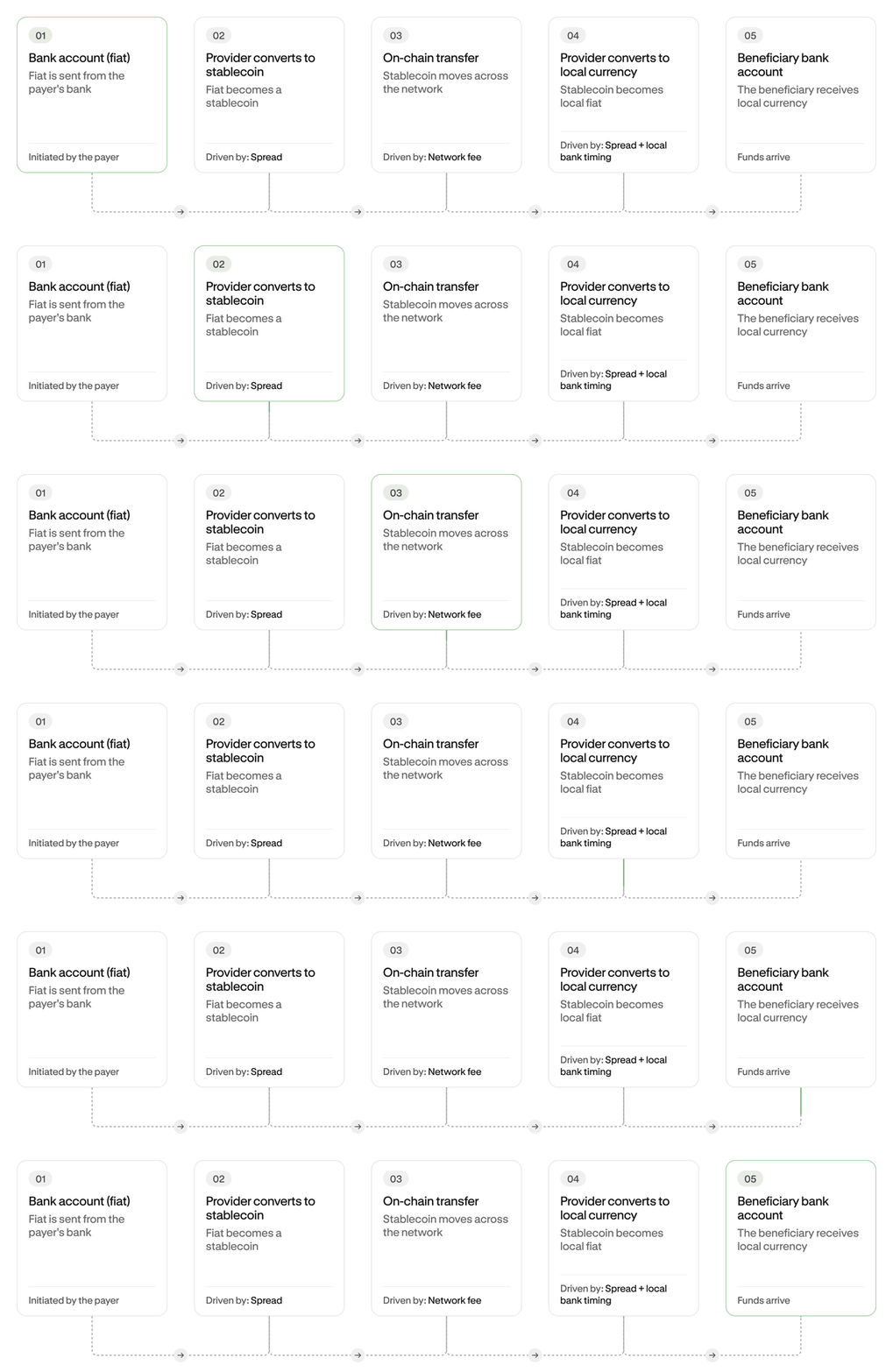
1. Convert fiat into stablecoins
The payer opens an account with an appropriately licensed provider and converts fiat currency into stablecoins at an agreed rate. This involves onboarding, know-your-customer (KYC), anti-money-laundering (AML) and sanctions checks, source-of-funds review and funding from the company’s own bank account.
These are not one-off formalities. A regulated provider applies its controls to each transaction, including screening of wallet addresses and the information-sharing requirements for virtual asset transfers known as the Travel Rule. For a VARA-licensed provider, every conversion must meet VARA’s rules and the provider’s own compliance policies. A stablecoin route is not a way to bypass the checks that apply to a bank transfer.
The initial funding transfer follows the applicable banking timelines. A new banking relationship or additional transaction review can add time. The conversion cost typically includes a spread against a reference rate and may include a separate provider fee. For larger transactions, an over-the-counter (OTC) desk can provide a firm quote for the full amount.
2. Transfer the stablecoins on-chain
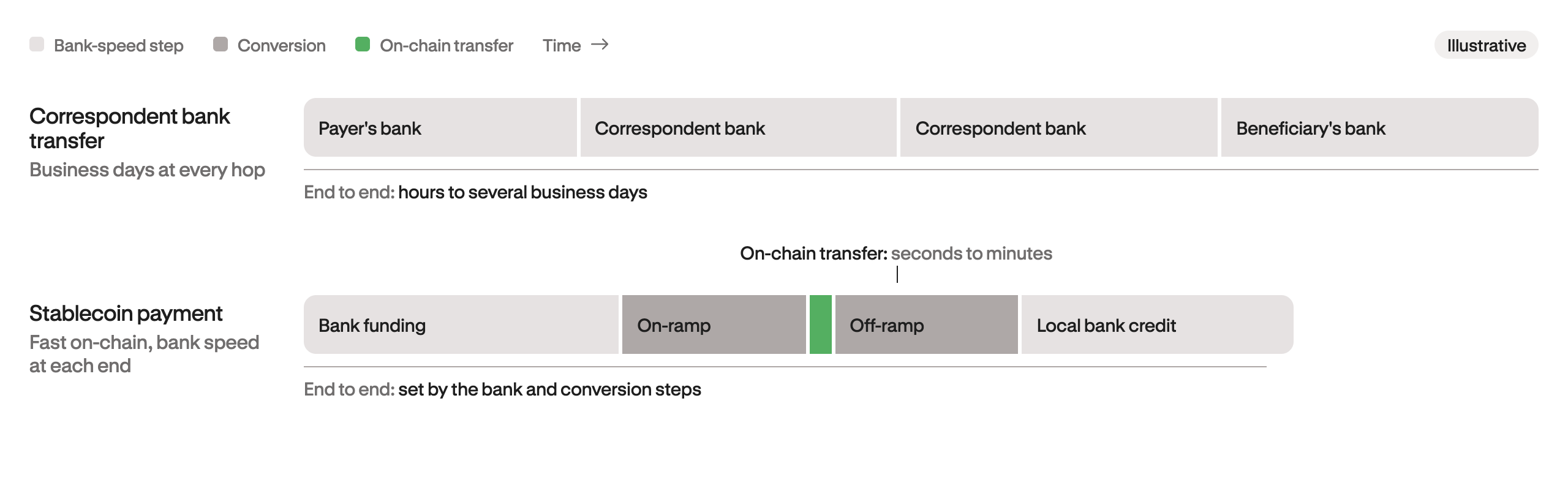
The tokens are sent to the beneficiary’s wallet. Depending on the network and the beneficiary’s confirmation requirements, this stage can take seconds or minutes. Transfers can occur on weekends and public holidays, and the network fee is often small relative to the value of a business transaction.
Once confirmed, a transfer generally cannot be recalled or charged back. Sending tokens to the wrong address or using an unsupported network can result in permanent loss.
Approve beneficiary addresses in advance, require dual authorisation for releases and make a small test transfer before sending a large amount to a new beneficiary. Document how wallet details are added, verified and changed.
3. Convert stablecoins into local currency
If the beneficiary needs local currency, it must convert the tokens through its own appropriately authorised provider and receive the proceeds into its bank account. This conversion and withdrawal process is known as the off-ramp.
The beneficiary may struggle to find a provider that can onboard it, and conversion spreads can be wide in markets with limited liquidity. The beneficiary’s provider will apply its own KYC, AML and sanctions checks. The final credit follows local banking timelines, and the receiving bank may ask for evidence of the source of funds. A transfer that takes minutes on-chain can still take longer to reach the beneficiary’s bank account.
Test the route with a small transaction and measure the elapsed time and cost from the payer’s bank debit to cleared funds in the beneficiary’s account.
Are stablecoins cheaper than bank transfers?

Stablecoins can reduce costs in some corridors. The comparison depends on the full cost of delivering funds to the beneficiary.
For a stablecoin route, include the on-ramp spread and fees, the network fee, the off-ramp spread and any local payout or provider charges. For a bank transfer, include the FX margin, intermediary deductions and any charges imposed by the beneficiary’s bank.
Where their use is permitted, stablecoins may be competitive when bank transfers are slow, expensive or involve several intermediaries. A bank transfer between major currencies may still be cheaper at institutional FX rates. The result depends on the corridor, transaction size, counterparties, local liquidity and the pricing available at the time.
Published remittance data can show how expensive small cross-border payments are in some corridors. Corporate treasury teams should compare live quotes for the same transaction size, beneficiary currency and settlement deadline.
Stablecoins vs bank transfers
| Feature | Correspondent bank transfer | Stablecoin route |
|---|---|---|
| Transfer-leg settlement | Hours to several business days, depending on the corridor and intermediaries | Seconds to minutes on-chain, depending on network and confirmation requirements |
| Availability | Depends on cut-offs, banking calendars and the banks involved | On-chain transfers run continuously. Fiat funding and withdrawal have separate timelines |
| Main cost drivers | FX margin, intermediary deductions and bank charges | Conversion spreads, network fees and provider or payout charges |
| Effect of transaction size | Some charges are fixed. FX cost in currency terms generally increases with transaction size | Network fees typically do not scale with the amount sent. Conversion costs depend on size and liquidity |
| Reversibility | Recall or investigation may be available | Confirmed transfers are generally final |
| Beneficiary requirements | A bank account | A compatible wallet and, for fiat, access to a licensed off-ramp |
| Key counterparty exposures | Banks and other intermediaries in the chain | The stablecoin issuer and the regulated providers involved in conversion |
| Compliance controls | KYC, AML, sanctions screening and transaction monitoring by each bank | The same KYC, AML, sanctions screening and transaction monitoring by each regulated provider, plus wallet screening and Travel Rule information-sharing |
| Permitted use | Fiat transfers are a generally accepted way to settle commercial obligations, subject to exchange controls and local rules | Varies more widely. Jurisdictions differ on which tokens are recognised, what they may be used for and which activities need a licence. In the UAE, CBUAE rules restrict the use of foreign-currency stablecoins for goods and services |
| Audit trail | Standard transaction records and bank documentation | On-chain transaction records plus provider statements and internal reconciliation |
Where bank transfers still win
For many companies, bank transfers remain the simplest option. The infrastructure is already in place, staff know the process, and banks have established procedures for investigating transfers and providing records for auditors or tax authorities.
A business may consider a stablecoin route when a bank route creates a specific problem, such as lengthy settlement, limited banking access or charges that make smaller transfers uneconomic, and only where the use is permitted in each jurisdiction involved. Its value depends on how effectively it addresses that problem in the corridor in question.
Risks of stablecoin payments
Stablecoin payments introduce operational, counterparty and regulatory risks. Assess them with the same diligence applied to any new provider or treasury arrangement.
Peg and reserve risk
A fiat-referenced stablecoin can trade below its target value if markets question reserve quality or an issuer’s ability to meet redemptions. Even a brief deviation can cause a reconciliation discrepancy or shortfall. Contracts should specify the reference currency, the amount due in that currency and who bears any difference.
Freeze risk
Major issuers can block specified addresses in certain circumstances, including in response to valid legal orders. A business may face a compliance review or delayed access to funds if an incoming transfer is linked to suspicious activity. Screen counterparties and wallet addresses and establish a clear escalation process.
Irreversible transfers
An incorrect wallet address or unsupported network can result in permanent loss. Verify wallet and network details before releasing a transfer and document how the team handles transfer errors.
Issuer concentration
Stablecoin issuance is concentrated among a small number of private companies. A business that relies on one token is exposed to that issuer’s reserve structure and ability to process redemptions.
Off-ramp dependence
A route that requires local currency is viable only if the beneficiary can convert the tokens through a licensed provider and receive the proceeds at an acceptable cost and within the required timeframe. Test the beneficiary’s off-ramp as part of the full flow.
Banking and regulatory risk
A corporate bank may ask for supporting documentation when it receives funds from a virtual asset service provider. Discuss the planned activity and evidence requirements with relevant banking partners in advance. The same token can be subject to different rules across jurisdictions, and those rules can change.
Holding stablecoins between transactions is also a treasury policy decision, with implications for governance, risk and accounting.
Regulation and jurisdiction
Stablecoin regulation varies across markets. Depending on the jurisdiction and the activity, rules on electronic money, payments, securities or virtual assets may apply. Some jurisdictions have specific frameworks for fiat-referenced tokens or tokens used for payments.
Assess the rules where the payer, beneficiary and relevant providers operate. Key questions include the following.
- Is the intended use permitted for the company and its counterparties?
- Which entities and activities require a licence or registration?
- What consumer, investor or other protections apply?
- What tax, accounting and reporting obligations apply?
For businesses in the UAE
Businesses in the UAE should check the limitations and requirements imposed by the Central Bank of the UAE (CBUAE), the Virtual Assets Regulatory Authority (VARA) and other relevant regulatory bodies on the use of virtual assets before using them. Rules can differ between mainland UAE, Dubai, free zones and the financial free zones. The CBUAE’s Payment Token Services Regulation, for example, restricts the use of foreign-currency stablecoins as a means of payment for goods and services in the UAE.
Where a VARA-licensed provider is involved, each transaction must meet VARA’s requirements, including client onboarding and categorisation, AML and counter-terrorist-financing controls, sanctions screening and the Travel Rule.
Companies should obtain legal advice on the specific structure before using stablecoins for supplier invoices, payroll or material treasury transfers.
Why a regulated provider matters
Providers at each conversion point determine the pricing, screening process and options for withdrawing fiat to a corporate bank account. Check the regulator’s public register to verify the contracting entity, the scope of its licence and any conditions before transacting. Confirm what the provider is not licensed to do as well as what it is.
MidChains FZE holds a Virtual Asset Service Provider licence from Dubai’s Virtual Assets Regulatory Authority (VARA) for Broker-Dealer Services. The licence permits it to serve retail, qualified and institutional investors. The applicable VARA rules cover areas including client categorisation, best execution, conflicts management, disclosures and record-keeping.
How businesses and banks use stablecoins
Stablecoin payment activity is growing from a small base relative to the broader cross-border payments market. Measurement depends on how researchers identify payments and separate them from trading and other on-chain activity.
Businesses use stablecoins for cross-border accounts payable and receivable, internal treasury transfers and time-sensitive settlements in sectors such as logistics and commodities. McKinsey and Artemis estimated that business-to-business stablecoin payments accounted for approximately USD 226 billion in annual volume in 2025. The estimate covers global B2B activity, including transactions beyond cross-border use.
Banks are also developing tokenised deposits and related settlement systems. A tokenised deposit represents a deposit claim on a bank. A fiat-backed stablecoin depends on a separate issuer and its reserve and redemption arrangements. Alongside individual banks’ offerings, The Clearing House is developing an initiative to support settlement of tokenised deposits between participating banks.
Treasury teams considering a pilot can structure it around legal sign-off, clear controls, a defined exit route and processes that can adapt as rules and infrastructure develop.
Where MidChains fits
MidChains FZE is licensed by VARA for Broker-Dealer Services and can serve retail, qualified and institutional investors, subject to onboarding and eligibility. Within that licence, MidChains covers the conversion stage of a stablecoin route.
- OTC trading. Request a firm quote for the full trade size when buying or selling supported stablecoins against supported fiat currencies. Learn more on our OTC trading page.
- Fiat deposits and withdrawals. Fund your account from a bank account in your own name, and withdraw fiat proceeds to that same account. Learn more on our on- and off-ramps page.
- Cross-border use. MidChains does not carry out cross-border transfers or remittances for clients. Instead, it helps clients get ready to make their own: converting fiat into supported stablecoins through OTC trading, and withdrawing fiat back to their own named bank account. Any onward transfer from the client’s wallet is the client’s own decision and responsibility, and must be permitted under the rules that apply to it. Learn more on our cross-border settlement page.
All transactions are subject to MidChains’ onboarding, KYC, AML and sanctions screening requirements and to VARA rules. Availability depends on the client, jurisdiction, asset and transaction.
Questions to ask a stablecoin provider
- Which legal entity will we contract with, and which authority regulates it?
- Which licence permissions cover each service we intend to use, and which services does the provider not offer?
- Which stablecoins do you support, and what do their issuers disclose about reserves and redemption?
- What is the all-in price at our expected transaction sizes, including conversion costs at both ends?
- Which currencies and countries can you support for withdrawals, and where is liquidity or provider access limited?
- What is the end-to-end timeline, including compliance checks, banking cut-offs and the final bank credit?
- How do you handle a wrong-address transfer, an incorrect network or a query from the beneficiary’s bank?
- How do you screen incoming tokens, and what happens if an issuer or provider freezes a balance?
- What reporting will we receive, and will it meet our auditor’s requirements?
- Is the intended use permitted in every jurisdiction where funds are received, converted or transferred?
Confirm the legal position in each jurisdiction before piloting the route.
Frequently asked questions
How do stablecoins work for cross-border payments?
The payer converts fiat into stablecoins through a licensed provider and sends them to the beneficiary’s wallet over a blockchain. If the beneficiary needs local currency, it converts the tokens through its own authorised provider. The transfer itself can take seconds or minutes. Compliance checks, conversion and local withdrawal affect the full cost and timeline.
Are stablecoins cheaper than bank transfers?
They can be in some corridors. Compare the all-in cost of both routes for the same amount and settlement deadline. For a stablecoin route, include conversion spreads, network and provider fees, and local payout charges.
Are stablecoin payments instant?
The wallet-to-wallet transfer can be fast. When the beneficiary needs local currency, the relevant measure is when it can use the funds in its bank account. Compliance checks, conversion and bank processing can extend that timeline.
Can a company settle supplier invoices in USDT?
It depends on the jurisdiction and the structure of the transaction. Some jurisdictions restrict the use of foreign-currency stablecoins for ordinary commercial transactions. In the UAE, for example, CBUAE rules restrict the use of foreign-currency stablecoins for goods and services. Obtain legal advice on the specific arrangement before proceeding.
What are the risks of stablecoin payments for businesses?
The main risks include a break in the peg, reserve or issuer problems, address freezes, irreversible transfers, limited off-ramp access, bank scrutiny and differences in regulation. Assess these risks across the entire route.
Final considerations
Stablecoins can move value between wallets around the clock without correspondent banks on the blockchain leg. The surrounding conversion, banking, regulatory and compliance steps still determine whether a business can use the route at all, and whether it can use it effectively.
For many businesses, bank transfers remain the right choice. If a corridor is slow, expensive or time-sensitive, confirm the legal position in each jurisdiction first, then price the full route, test the beneficiary’s off-ramp and document the controls before scaling.
MidChains FZE is licensed by VARA for Broker-Dealer Services and may serve retail, qualified and institutional investors. If your team would like to discuss OTC trading or fiat deposits and withdrawals, contact MidChains.
Important information
Virtual assets, including stablecoins:
- may lose their value in full or in part and are subject to extreme volatility at times;
- may not always be transferable, and some transfers may be irreversible;
- may not be liquid;
- may be recorded on public distributed ledgers, so some transactions are not private;
- may be subject to fraud, manipulation and theft, including through hacks and other targeted schemes.
You may lose all or part of the money or other value you invest. There is no guarantee of value or return. Virtual assets are not bank deposits and do not benefit from any form of financial protection, including deposit protection or compensation schemes.
This article refers to information published by third parties, including stablecoin issuers, researchers and industry bodies. MidChains has not independently audited or verified those issuer disclosures or other third-party information, and the risk of relying on them remains with the client. Links are provided for reference only.
Businesses in the UAE should check the limitations and requirements imposed by the CBUAE, VARA and other relevant regulatory bodies on the use of virtual assets.
MidChains FZE is licensed by the Virtual Assets Regulatory Authority (VARA) for Broker-Dealer Services (licence no. VL/25/04/008).
This article is for informational purposes only and does not constitute legal, financial, tax or investment advice, or an offer or recommendation to buy, sell or hold any virtual asset.
More Articles
Explore our latest insights.